Andorra
Andorra, a small principality in the Pyrenees between Spain and France, serves in the novel as the site of Silas's imprisonment and the crucible of his transformation. It is the place where the ghost-like young man, already hardened by a life of violence and rejection, was confined for twelve years after killing a sailor who attacked him. The prison's stone cells, the stench of human waste, and the howling wind of the mountains became the physical and psychological walls that defined his existence. It was here that the inmates mocked him as a ghost, and he came to believe he was transparent, weightless, a specter walking the world alone. The prison's brutal conditions, including the cold and the cries of hopelessness, stripped him of his former identity and left him in a state of near-total despair, a purgatory from which he thought he would never escape.
The Earthquake and Escape
The turning point in Silas's life occurred during a powerful earthquake that shook the foundations of the Andorran prison. The trembling earth dislodged a large boulder from the wall of his cell, which fell onto the very spot where he had been sleeping. Through the hole in the wall, he saw the moon for the first time in over a decade. Driven by a primal instinct for survival, he scrambled through the narrow tunnel, staggered out into an expansive vista, and tumbled down a barren mountainside into the woods. He ran all night, delirious with hunger and exhaustion, until he collapsed by a train track. This physical escape from the prison walls was the first step in a spiritual journey that would lead him to a new life.
Aftermath and Rebirth
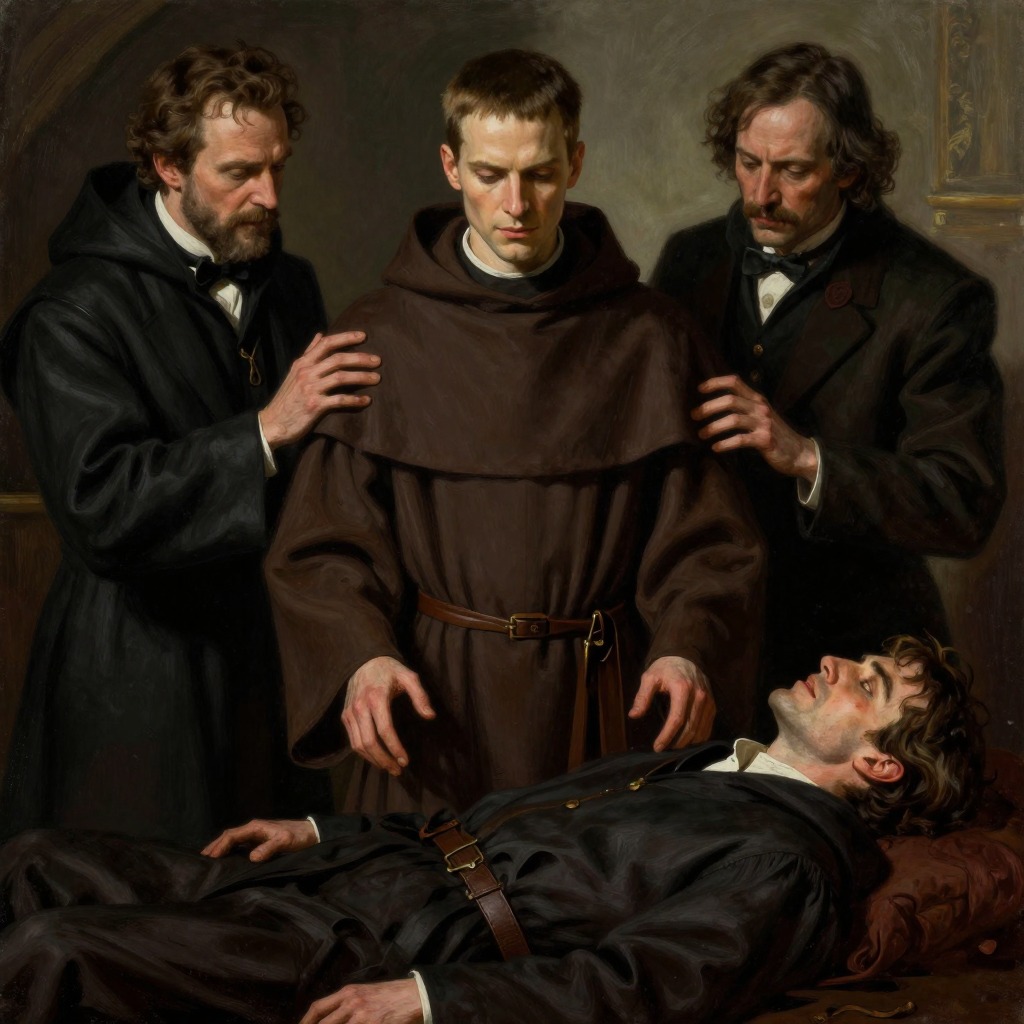
After escaping, Silas wandered in a daze, eventually stowing away on a freight train. He was discovered and thrown off, bloody and weak, in the north of Spain. He collapsed by the side of the road, near death. He was found and taken in by a young missionary priest, Manuel Aringarosa, who nursed him back to health. When Silas awoke, he saw a crucifix and heard a voice telling him he was saved. Aringarosa showed him a newspaper clipping about the earthquake that had destroyed the prison, revealing that he knew Silas's past. Instead of turning him in, the priest gave him a Bible, pointing to the story of the prisoner Silas in Acts 16, whose prison doors were opened by an earthquake. From that moment, the ghost was given a new name and a new purpose, his past in Andorra becoming the foundation of his fanatical devotion.
Narrative Role and Significance
Andorra functions as the symbolic underworld from which Silas emerges, a place of death and despair that is necessary for his rebirth as a soldier of God. The earthquake, a natural disaster, is interpreted by both Silas and Aringarosa as an act of divine intervention, a miracle that freed him for a holy purpose. The memory of Andorra haunts Silas throughout the novel, a constant reminder of the man he was and the debt he owes to Aringarosa. This debt makes him a willing instrument in the Teacher's plot, as he believes he is repaying his salvation by doing God's work. The location thus serves as the origin point for Silas's tragic arc, a past that is both a source of pain and the justification for his violent actions in the present.